Credit card debt is the most expensive debt most people carry. With typical card APRs above 20%, a balance can sit for years while you pay hundreds of dollars a year in interest. The good news is that card debt also responds quickly to a clear plan. Small changes to how much you pay, and in what order, can take years off the timeline.
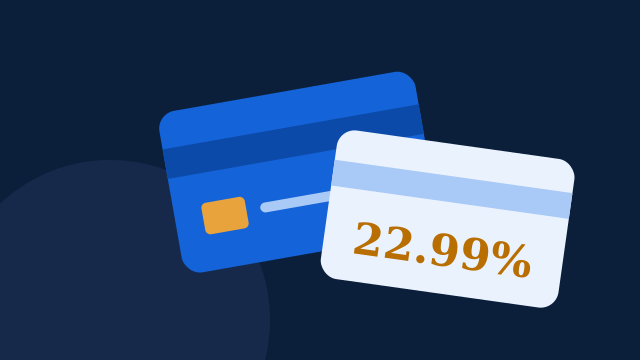
This guide walks through a six-step plan and uses one example throughout: a $5,000 balance at 22.99% APR.
Why credit card debt is so hard to shift
Card interest is charged on whatever balance you carry. At 22.99% APR, the monthly rate is roughly 1.92%, so a $5,000 balance costs about $96 in interest in the first month alone. If your payment is only a little more than that, almost nothing goes toward the balance itself.
Minimum payments make this worse. Many US issuers set the minimum at around 1% of the balance plus that month’s interest, with a floor of about $25 to $35. UK lenders follow a similar pattern under FCA rules. As the balance falls, the minimum falls too, so the debt shrinks slower and slower.
Here is what that means for our example, comparing a typical minimum-payment formula with three fixed payments:
| Monthly payment | Time to pay off | Total interest |
|---|---|---|
| Minimum only (1% + interest, $35 floor) | 199 months (16.6 years) | $8,053 |
| Fixed $150 | 54 months | $3,045 |
| Fixed $250 | 26 months | $1,366 |
| Fixed $400 | 15 months | $771 |
Paying only the minimum costs more in interest than the original balance. Paying a fixed $250 instead clears the card more than 14 years sooner and saves about $6,700. That gap is the whole reason this plan works.
Step 1: Stop adding to the balance
Every new purchase on the card pushes your payoff date back. Move recurring subscriptions and everyday spending to a debit card or cash while you pay the card down. You don’t have to close the account. In fact, keeping it open usually helps your credit score because it keeps your available credit higher. Just stop using it for now.
Step 2: Know your exact numbers
Find three numbers on your latest statement: the balance, the purchase APR and the minimum payment. If you have more than one card, list them all. Many people are surprised to find that one card has a much higher rate than the others, or that a promotional 0% rate is about to end.
Enter the balance and APR into our credit card payoff calculator to see your current debt-free date. That date is your baseline. Every step below is about pulling it closer.
Step 3: Pick a fixed payment and stick to it
The single most powerful change is to stop paying the minimum and pay a fixed amount every month instead. A fixed payment doesn’t shrink as your balance falls, so more of it goes toward the principal each month.
Choose an amount you can keep paying even in a tight month. It’s better to commit to $250 and always pay it than to aim for $400 and miss. Set it up as an automatic payment a few days after payday so the decision is made once, not every month.
Step 4: Find extra money to add
Once the fixed payment is automatic, look for one or two places to free up cash. Common sources include cancelling unused subscriptions, switching mobile or broadband plans, and setting a weekly limit for takeaways and eating out. Our guide on finding an extra $100 a month has more ideas.
Windfalls help too. A tax refund, a work bonus or money from selling things you no longer use can go straight onto the card. A one-off $1,000 payment on a $5,000 balance at 22.99% removes about $230 of interest in the first year alone.
Step 5: Choose an order if you have several cards
With more than one card, pay the minimum on all of them and send every extra dollar to one target card. There are two good ways to choose the target:
- Avalanche: target the card with the highest APR first. This saves the most interest. Try it with the debt avalanche calculator.
- Snowball: target the smallest balance first. You clear whole cards sooner, which helps many people stay motivated. Try it with the debt snowball calculator.
When the target card hits zero, add its whole payment to the next card on your list. Your total monthly budget stays the same, but it gets more powerful each time a card is cleared. Our snowball vs. avalanche guide compares the two methods with real numbers.
Step 6: Lower the interest rate if you can
A lower rate means more of every payment goes to the balance. Three options are worth checking:
- Ask your card issuer. If you’ve paid on time for a while, a short call asking for a lower APR sometimes works. It costs nothing to ask.
- Balance transfer card. A 0% promotional period can stop interest completely for a while, usually in exchange for a one-off fee. See our guide on whether a balance transfer saves money.
- Debt consolidation loan. A personal loan at a lower fixed rate can replace several card balances with one payment. Our consolidation loan guide shows when this helps.
A lower rate only helps if you keep paying the same amount. If you cut your payment because the interest dropped, you lose most of the benefit.
Common mistakes that slow you down
- Paying late. A late payment can trigger a fee and, on some US cards, a penalty APR near 30%. Automatic payments prevent this.
- Running the balance back up. After a balance transfer or consolidation loan, the old cards have a zero balance. Spending on them again leaves you with two debts instead of one.
- Skipping an emergency fund entirely. Without a small cushion, the next car repair goes straight back on the card. A starter fund of a few hundred dollars or pounds breaks this cycle. Read emergency fund or debt first? for how to balance the two.
- Waiting for the perfect plan. Any fixed payment above the minimum, started this month, beats a better plan started next year.
How long will it take you?
Using our example, the difference between paying $150 and $250 a month is 28 months and about $1,680 in interest. The difference between $250 and $400 is another 11 months and about $595. The first increase above the minimum always does the most work, so even a modest change makes a real difference.
Put your own numbers into the credit card payoff calculator and try a few payment amounts. Pick the one that gives you a debt-free date you’re happy with and a payment you know you can keep up.
Quick summary
- Stop using the card while you pay it off.
- Replace the minimum payment with a fixed amount, paid automatically.
- Add extra money and windfalls to one target card at a time.
- Use the avalanche or snowball method if you have several cards.
- Look for a lower rate, but keep your payment the same when you get one.
Figures assume a constant APR, monthly interest at APR ÷ 12, on-time payments and no new purchases or fees. Your card issuer may calculate interest daily, so real results can differ slightly.
This guide is general education, not personal financial advice. For advice about your situation, talk to a qualified, licensed professional.