Your card statement shows an APR, but you’re never charged that full percentage at once. Here’s how the number on your statement turns into the interest charge you actually pay.
APR in plain terms
APR stands for annual percentage rate: the yearly cost of borrowing, expressed as a percentage. Card issuers split it into smaller periods. Most use a daily periodic rate — APR ÷ 365 — applied to your average daily balance over the billing cycle.
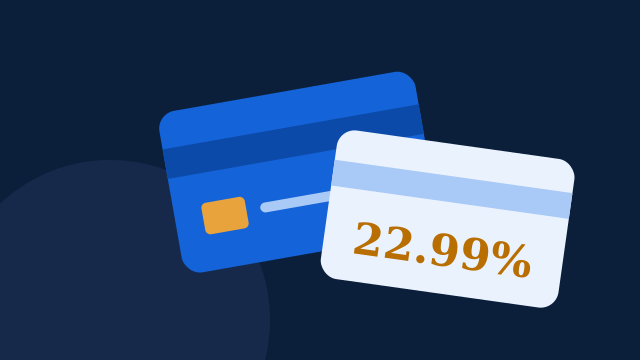
Monthly equivalent ≈ 22.99% ÷ 12 = 1.92% per month
Over a month, the daily method and the simpler monthly method give almost the same result, which is why our calculators use APR ÷ 12.
Example: a $6,500 balance
If you pay $250, only about $125 of it reduces the balance. The rest is interest. Next month the balance is a bit lower, so interest is a bit lower, and slightly more of your payment goes to the balance. That slow shift is why paying off a card takes so long at low payments.
| Monthly payment | Time to pay off | Total interest |
|---|---|---|
| $250 | 37 months | $2,582 |
| $350 | 24 months | $1,611 |
An extra $100 a month gets you out 13 months sooner and saves $971.
The grace period
If you pay your full statement balance by the due date, most cards charge no interest on new purchases. Once you carry a balance, you usually lose that grace period until you pay in full again.
Things that make interest higher
- Penalty APR after a late or missed payment.
- Cash advances, which often have a higher rate and no grace period.
- Promotional rates ending, when the standard APR applies to any balance left.
How the daily method works in practice
Most card issuers don’t charge interest on your statement balance. They use your average daily balance across the billing cycle. Every day, the issuer records what you owe. At the end of the cycle, it adds those daily balances together, divides by the number of days, and charges the daily rate on that average for each day of the cycle.
Here’s a simple 30-day example at 22.99% APR:
- Days 1 to 15: you owe $2,000.
- On day 16 you make a $500 payment, so for days 16 to 30 you owe $1,500.
- Average daily balance: ($2,000 × 15 + $1,500 × 15) ÷ 30 = $1,750.
- Interest: $1,750 × 22.99% ÷ 365 × 30 = about $33.07.
This has a useful side effect: paying earlier in the cycle lowers your interest. If you made the same $500 payment on day 2 instead of day 16, your average daily balance would be lower, and so would the interest. Paying as soon as you’re paid, rather than waiting for the due date, is a small but free saving.
Why minimum payments keep you in debt
Many US issuers set the minimum payment at about 1% of the balance plus that month’s interest, with a floor of around $25 to $35. UK lenders use similar formulas. The problem is that the minimum falls as your balance falls, so you pay off less and less each month.
On the same $6,500 balance at 22.99%, paying only a minimum of 1% plus interest (with a $35 floor) would take about 225 months, almost 19 years, and cost around $10,927 in interest. That’s far more than the original balance.
| How you pay | Time to pay off | Total interest |
|---|---|---|
| Minimum only (1% + interest, $35 floor) | About 225 months | About $10,927 |
| Fixed $250 a month | 37 months | $2,582 |
| Fixed $350 a month | 24 months | $1,611 |
A fixed payment beats the minimum because it doesn’t shrink. As interest falls, more of the same payment reduces the balance, and the payoff speeds up month after month. Our guide on how to pay off credit card debt fast shows how to set one up.
What a penalty APR really costs
Some US cards raise your rate to a penalty APR, often close to 30%, after a late or missed payment. On the same $6,500 balance with a $250 payment, moving from 22.99% to 29.99% would stretch payoff from 37 to 43 months and raise total interest from $2,582 to about $4,127. One late payment can cost far more than the late fee itself.
Setting up an automatic payment for at least the minimum is the simplest protection. You can still pay more manually whenever you want. In the UK, penalty rate increases are less common, but late fees and damage to your credit file still apply.
Cash advances and balance transfers
Different parts of your balance can have different rates. Cash advances, such as withdrawing cash with your card, usually carry a higher APR, a fee of around 3% to 5%, and no grace period, so interest starts from day one. Avoid them except in a real emergency.
Balance transfers can work the other way, with a 0% promotional rate for a set period. If you’re considering one, our guide on whether a balance transfer saves money shows how to check the numbers, including the fee.
How to pay less interest, starting this month
- Pay a fixed amount above the minimum, automatically, every month.
- Pay early in the cycle to lower your average daily balance.
- Stop new purchases on the card while you pay it down.
- Never pay late, to avoid fees and penalty rates.
- Ask for a lower APR if you have a good payment record.
- Pay the most expensive card first if you have several. See our snowball vs. avalanche guide.
Questions to ask your card issuer
A short call or secure message can clear up exactly how your card charges interest. Useful questions include:
- What is my current purchase APR, and is it fixed or variable?
- Do any parts of my balance have different rates, such as cash advances or promotional balances?
- When does any promotional rate end, and what rate applies after that?
- Can you lower my APR based on my payment history?
Write down the answers and the date of the call. If anything changes later, you’ll have a record of what you were told.
Check your own card
Put your balance, APR and payment into the credit card payoff calculator to see your payoff date and what a bigger payment would save.
This guide is general education, not personal financial advice. For advice about your situation, talk to a qualified, licensed professional.