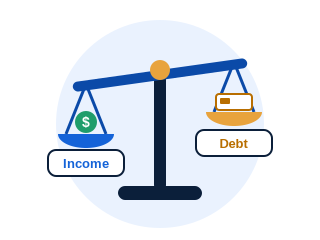
Short answer: Your debt-to-income ratio (DTI) is your total monthly debt payments divided by your gross monthly income. If you pay $2,300 a month toward debts and earn $6,000 before tax, your DTI is 38.3%. A DTI of 36% or less is generally seen as healthy. Many mortgage programs allow more: up to 43% for a standard FHA loan and up to 50% for a conventional loan approved through Fannie Mae’s automated system.
How to use this DTI calculator
- Enter your gross monthly income. Use your pay before taxes and deductions, plus any other regular income. If you know your yearly salary, divide it by 12.
- Enter your monthly housing payment. Rent, or your full mortgage payment including property tax, homeowners insurance and HOA dues.
- Enter your other debt payments. Use the monthly amounts you’re required to pay: car and student loans, the minimum payment on each credit card, personal loans, and child support or alimony. Leave a box blank if it doesn’t apply.
The calculator shows your total DTI, your housing ratio, how much room you have before 36%, and how lenders’ common limits compare with your number.
What not to include
DTI only counts debt payments. Don’t include groceries, utilities, phone bills, car insurance, health insurance, subscriptions or other living costs, even though they’re part of your budget.
How to calculate your debt-to-income ratio
The Consumer Financial Protection Bureau defines DTI as all your monthly debt payments divided by your gross monthly income:
DTI = total monthly debt payments ÷ gross monthly income × 100
Example
| Monthly payment | Amount |
|---|---|
| Rent or mortgage | $1,500 |
| Car loan | $400 |
| Student loan | $250 |
| Credit card minimum payments | $150 |
| Total debt payments | $2,300 |
| Gross monthly income | $6,000 |
$2,300 ÷ $6,000 = 0.383, so the DTI is 38.3%. To get down to 36%, total payments would need to fall to $2,160, a cut of $140 a month, or income would need to rise by about $389 a month.
Front-end vs back-end DTI
Mortgage lenders often look at two ratios:
- Front-end ratio (housing ratio): only your housing payment divided by gross income. In the example, $1,500 ÷ $6,000 = 25%.
- Back-end ratio (total DTI): all your debt payments, including housing, divided by gross income. This is the number most people mean by “DTI”, and it’s the one lenders weigh most.
You may hear of the 28/36 rule: housing at no more than 28% of gross income, and total debt at no more than 36%. It’s a useful target rather than a hard limit.
What is a good debt-to-income ratio?
The CFPB suggests that homeowners keep total DTI at 36% or less. Wells Fargo uses three bands that match how many lenders think:
| DTI | What it usually means |
|---|---|
| 36% or less | Healthy. Your debt is manageable relative to your income, and lenders view it favorably. |
| Above 36% up to 49% | Room to improve. You’re managing, but a lower DTI leaves more room for surprises, and lenders may ask for more. |
| 50% or more | High. Over half your income goes to debt, leaving little to save, and borrowing options may be limited. |
How much debt is too much?
Your DTI is the simplest way to answer this. As a rule of thumb:
- Under 36%: usually manageable. You have room to save and handle surprises.
- 36% to 43%: getting heavy. You can likely still borrow, but a job loss or big bill would be harder to absorb.
- Over 43%, and especially over 50%: too much for most people. A large share of every paycheck is already spoken for, and many lenders will say no.
A few other warning signs that your debt is too high, whatever your DTI:
- You can only afford the minimum payments, and balances aren’t going down.
- You use credit cards to pay for groceries or bills because cash runs out.
- Your credit utilization is above 30% on most cards.
- You have no savings to fall back on. See emergency fund vs paying off debt.
If several of these apply, the credit card payoff calculator will show how long your balances will take at your current payment, and what a higher payment would change.
Maximum DTI by loan type
There is no single legal maximum DTI. Each loan program sets its own guidelines, and lenders can be stricter:
| Loan type | Typical DTI limit |
|---|---|
| Conventional (Fannie Mae, automated approval) | Up to 50% |
| Conventional (Fannie Mae, manual review) | 36%, or up to 45% with strong credit and savings |
| FHA | 31% housing / 43% total as the standard, higher with compensating factors |
| VA | 41% guideline, not a hard cap; leftover monthly income also matters |
| USDA | 29% housing / 41% total for manual review |
The Fannie Mae figures come from its Selling Guide. You may still read that 43% is the legal maximum for a mortgage. That was true for “qualified mortgages” until the CFPB replaced the 43% limit with a price-based test, so many lenders now go higher.
For personal loans and credit cards, lenders also consider DTI, though most don’t publish a cut-off. Under about 36% puts you in the strongest position.
Does your DTI affect your credit score?
No. Your income isn’t on your credit report, so DTI isn’t part of your credit score. But the two are linked: the balances behind your debt payments affect your credit utilization, which does affect your score. Lenders look at both your score and your DTI when deciding whether to approve you.
How to lower your debt-to-income ratio
- Pay off a debt with a large monthly payment. Clearing a $400 car loan drops DTI faster than paying down a card with a $40 minimum. The debt snowball calculator shows how fast you can clear small balances and free up their payments.
- Cut your interest costs. The debt avalanche calculator targets the highest rate first, which shortens how long you carry the debt.
- Lower your payments. A debt consolidation loan or a 0% balance transfer can reduce the monthly amount you owe, though a longer term can mean more interest overall.
- Avoid new debt before applying for a mortgage or loan, and don’t open new cards in the months before.
- Increase your income, or add a co-borrower whose income counts toward the application.
For the full picture on card balances, see our guide to credit card debt.
Debt-to-income ratio in the UK
UK lenders don’t use a single DTI cut-off. They run affordability checks that look at your income, existing credit commitments and regular spending. The same idea applies, though: the less of your income already goes to debt, the easier it is to be approved. You can enter your figures in pounds and the percentages work the same way.
Reviewed by Ahmar Sultan, Chartered Accountant. This calculator is for general information and is not financial or lending advice. Lenders set their own rules and may count income and debts differently.