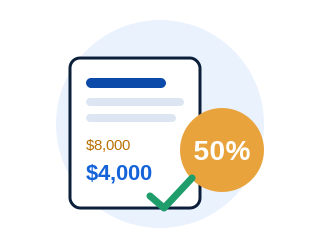
Short answer: A debt settlement lets you pay less than you owe, but the “savings” are smaller than they look. Settling an $8,000 debt for 50% means paying $4,000. Up to $4,000 of forgiven debt can then count as taxable income, and a settlement company may charge 15% to 25% of the debt. This calculator shows what you would really keep after tax and fees, and how long it would take to save the lump sum.
How to use this debt settlement calculator
- Amount you owe: the current balance on the account you want to settle.
- Settlement offer: the share of the balance you plan to pay. Many settlements land somewhere between 30% and 70%.
- Monthly savings: how much you can set aside toward a lump-sum offer.
- Tax rate: your federal income tax bracket, used to estimate tax on the forgiven amount.
- Company fee: leave it at 0% if you negotiate yourself. Settlement companies often charge a percentage of the debt.
How the numbers are worked out
- Settlement payment = balance × offer %
- Debt forgiven = balance − settlement payment
- Possible tax = debt forgiven × your tax rate (when $600 or more is forgiven)
- Company fee = balance × fee %
- Net savings = debt forgiven − tax − fee
Example
| $8,000 credit card debt, 50% settlement | Do it yourself | Through a company (20% fee) |
|---|---|---|
| You pay the creditor | $4,000 | $4,000 |
| Debt forgiven | $4,000 | $4,000 |
| Possible tax at 22% | $880 | $880 |
| Company fee | $0 | $1,600 |
| Net savings | $3,120 | $1,520 |
Negotiating yourself more than doubles what you keep in this example. Our step-by-step guide shows how to negotiate debt settlement on your own.
Is forgiven debt taxable?
Usually, yes. The IRS treats canceled debt as ordinary income, and creditors generally send Form 1099-C when $600 or more is forgiven. There are exceptions. The most common is insolvency: if your total debts were higher than the value of everything you owned right before the debt was canceled, you may be able to exclude some or all of it using Form 982. IRS Publication 4681 has the worksheet. Because this depends on your situation, the calculator shows the tax as “possible”.
Settlement company fees
Under the FTC’s Telemarketing Sales Rule, debt relief companies can’t charge you any fee until they’ve settled at least one of your debts and you’ve made at least one payment under that agreement. Be wary of any company that asks for money up front. Experian notes fees can reach 25% of the debt.
Before you settle
- Your credit will take a hit. A settled account is reported as “settled for less than the full amount” and stays on your credit report for seven years from the first missed payment. See what happens when you miss credit card payments.
- Check cheaper options first. A hardship program, a nonprofit debt management plan or a debt consolidation loan may cost less overall and protect your credit better.
- Compare with paying in full. The credit card payoff calculator shows how long full repayment would take, so you can weigh the two.
For every option for card balances, see our guide to credit card debt.
Debt settlement in the UK
In the UK, the same idea is called a full and final settlement. Forgiven consumer debt isn’t usually taxed as income, so you can set the tax rate to 0%. Free debt advice charities such as StepChange, Citizens Advice and MoneyHelper can help you decide whether a settlement, a debt management plan or another solution fits best.
Reviewed by Ahmar Sultan, Chartered Accountant. This calculator gives an estimate for general information only. It is not tax, legal or financial advice. Your actual tax depends on your full tax situation.