
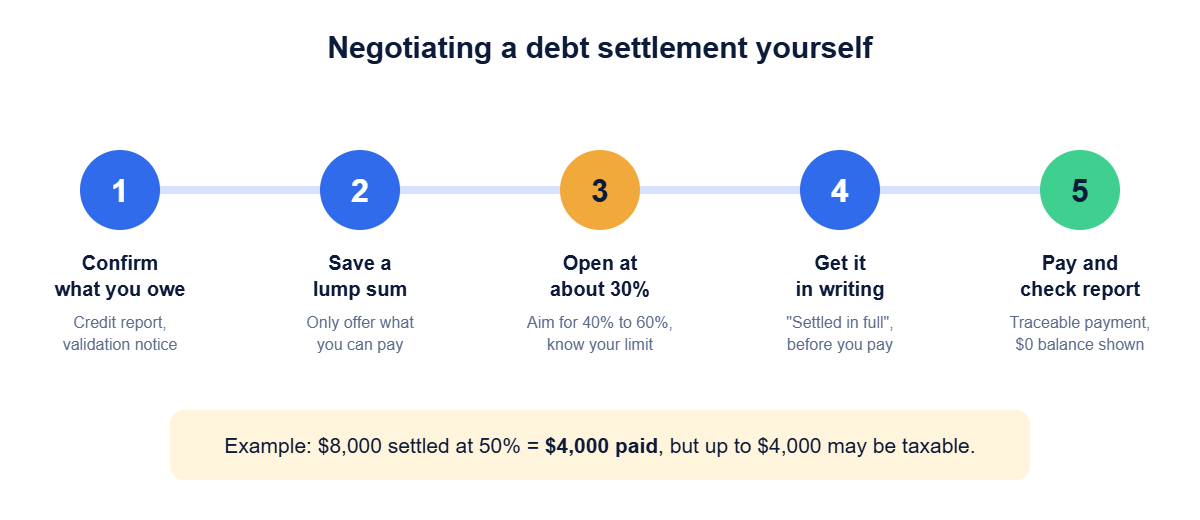
Short answer: To negotiate a debt settlement on your own, confirm exactly what you owe, work out a lump sum you can actually pay, then call or write to the creditor with an opening offer of around 30% of the balance. Expect to meet somewhere in the middle, often 40% to 60%. Get the agreement in writing before you pay, pay with a traceable method, and check your credit report afterward. Doing it yourself avoids settlement company fees, which can reach 25% of the debt.
Is settling a debt a good idea?
Settlement can make sense when you are already behind, can’t realistically repay the full balance, and can raise a lump sum. It is usually a last step before bankruptcy, not a first choice.
| Pros | Cons |
|---|---|
| You pay less than the full balance | Your credit score drops, and the “settled” status stays for seven years |
| The debt is closed, so collection calls stop | Forgiven debt of $600 or more can be taxed as income |
| Faster than years of minimum payments | Creditors usually only settle after you’ve fallen well behind |
| Doing it yourself costs nothing extra | No guarantee the creditor will agree |
If you are still current on your payments, look at cheaper options first: a hardship program with your card issuer, a nonprofit debt management plan, or a debt consolidation loan.
When will a creditor agree to settle?
Timing matters. Experian notes that creditors rarely negotiate when a payment is only a few weeks late. Settlement is usually considered once an account is at least 90 days past due. Between 120 and 180 days late, a credit card is typically charged off and often sold to a debt collector, who may accept less because they bought the debt for a fraction of its value.
Every month you wait also adds late fees, interest and more damage to your credit. See what happens when you miss credit card payments for the full timeline.
How to negotiate debt settlement on your own: 7 steps
1. Confirm exactly what you owe
Check your free credit reports at AnnualCreditReport.com and your latest statements. If a collector contacts you, ask for a validation notice showing the amount and the original creditor. You can dispute the debt in writing within 30 days of receiving it.
2. Work out what you can pay
Creditors take lump-sum offers more seriously than payment plans. Decide on a realistic amount from savings, a tax refund or help from family, and don’t offer more than you can pay. Our debt settlement calculator shows how long it would take to save a lump sum and what you’d keep after tax.
3. Decide your offer range
Settle on three numbers before you call: an opening offer, a realistic target, and a limit you won’t go above.
| On an $8,000 balance | Share of balance | Amount |
|---|---|---|
| Opening offer | 30% | $2,400 |
| Realistic target | 40% to 50% | $3,200 to $4,000 |
| Your walk-away limit | 60% to 70% | $4,800 to $5,600 |
4. Make the call (or write a letter)
Ask for the hardship or recovery department. Be calm, honest and brief. A simple script:
“I’ve had a financial setback and can’t pay the full balance of $8,000. I can make a one-time payment of $2,400 to settle this account in full. Can you accept that?”
Expect a counteroffer. Don’t share your bank details, and don’t agree on the first call if the number is above your limit. Ask for their best offer and say you’ll think about it.
5. Get the agreement in writing
Before paying anything, get a letter or email that states the settlement amount, the due date, and that the payment settles the account in full, with no remaining balance to be collected or sold. Ask how the account will be reported to the credit bureaus.
6. Pay with a traceable method
Pay exactly as the agreement says, on time. Use a method that leaves a record, such as a cashier’s check or a one-time card or bank payment that you start yourself. Avoid giving open access to your bank account.
7. Keep records and check your credit report
Save the agreement and proof of payment for at least seven years. After 30 to 60 days, check that your credit report shows the account as settled with a $0 balance.

How much should you offer to settle a debt?
There is no fixed rule. Experian says offering up to half of the balance is common. What you can get depends on:
- Who owns the debt. Debt buyers that paid a small fraction of the balance can often accept less than the original creditor.
- How old the debt is. Older, charged-off debts tend to settle for less.
- Lump sum vs payments. A single payment usually gets a bigger discount than an installment plan, which might run 12 to 24 months.
- Your situation. Proof of hardship, such as job loss or medical bills, helps.
Taxes on settled debt
The IRS generally treats forgiven debt as taxable income, and creditors usually send Form 1099-C when $600 or more is canceled. Settling $8,000 for $4,000 could add $4,000 to your income. At a 22% tax rate, that’s about $880 in tax.
You may not owe that tax if you were insolvent, meaning your total debts were larger than the value of everything you owned just before the debt was forgiven. You claim this with Form 982, and IRS Publication 4681 has a worksheet. Set some money aside or talk to a tax professional before the following tax season.
How debt settlement affects your credit
A settled account is reported as “settled” or “paid for less than the full amount.” It’s better than an unpaid collection, but it still lowers your score, and both the settlement and the late payments before it stay on your credit report for seven years from the first missed payment. Your score can recover over time if you pay everything else on time and keep your credit utilization low.
DIY settlement vs a debt settlement company
| Do it yourself | Settlement company | |
|---|---|---|
| Cost | Free | Often 15% to 25% of the enrolled debt |
| Control | You decide every offer | The company negotiates for you |
| Timeline | As soon as you have the lump sum | Often 2 to 4 years while you save in an account |
| Risk | Time and stress of negotiating | Late fees and lawsuits can pile up while you wait |
If you do use a company, the FTC’s Telemarketing Sales Rule bans fees until at least one debt has been settled and you’ve made at least one payment under that agreement. Any company asking for money up front is breaking the rule.
Mistakes to avoid
- Paying before you have the deal in writing. A verbal promise is hard to prove.
- Agreeing to payments you can’t keep. Missing an installment can cancel the settlement.
- Making a payment on a very old debt without checking the statute of limitations. In some states, any payment can restart the clock for a lawsuit.
- Forgetting the tax bill. Plan for a possible Form 1099-C.
Settling debt in the UK
In the UK, this is called a full and final settlement. The same steps apply: make a written offer, get written acceptance, and keep proof of payment. The account is usually marked as partially settled on your credit file for six years. Forgiven consumer debt isn’t usually taxed as income for individuals. StepChange, Citizens Advice and MoneyHelper offer free advice, including template letters.
Frequently asked questions
Can I negotiate debt settlement myself?
Yes. You can contact the creditor or collector directly and make an offer. There’s no legal requirement to use a company, and doing it yourself avoids fees.
What is a good percentage to offer for a debt settlement?
Many people open around 30% of the balance and settle between 40% and 60%. The final number depends on the age of the debt, who owns it and whether you can pay a lump sum.
Will settling a debt hurt my credit?
Yes. A settled account is a negative mark that stays on your credit report for seven years, though it’s viewed better than an unpaid debt.
Do I have to pay taxes on a settled debt?
Often. Forgiven debt of $600 or more is usually reported on Form 1099-C and may be taxable unless you qualify for an exclusion such as insolvency.
Is it better to settle or pay in full?
Paying in full is better for your credit if you can afford it. Settlement makes sense when full repayment isn’t realistic and you can raise a lump sum.
The bottom line
You can negotiate a debt settlement yourself and keep the fee a company would charge. Know your numbers before you call, start low, get everything in writing, and plan for the tax. Use the debt settlement calculator to see what an offer would really save you, and our guide to credit card debt for other options.
This guide is general education, not legal, tax or financial advice. Debt collection and tax rules vary by state and by your situation. Consider speaking with a nonprofit credit counselor, consumer attorney or tax professional.
Featured photo by Vitaly Gariev on Unsplash. Step graphic by DebtMathLab.
Sources
- Experian: how to negotiate credit card debt settlement yourself
- IRS Topic No. 431: Canceled debt, is it taxable or not?
- FTC: Debt relief services and the Telemarketing Sales Rule
This guide is general education, not personal financial advice. For advice about your situation, talk to a qualified, licensed professional.