
Short answer: To get a debt consolidation loan, add up the debts you want to clear, check your credit score and debt-to-income ratio, and work out how much to borrow (including any origination fee). Then prequalify with three or more lenders using a soft credit check, compare the APRs, and apply for the best offer. When the money arrives, pay off the old debts right away, or choose a lender that pays your creditors directly. A loan only helps if its APR is lower than what you pay now.
What you need to qualify
Every lender sets its own rules, but most look at the same four things.
| What lenders check | What usually helps |
|---|---|
| Credit score | A score in the mid-600s or higher gives you the best chance of approval. Lower scores can still qualify, but at higher rates. |
| Debt-to-income ratio (DTI) | Many lenders want 50% or less. Under 36% puts you in a stronger position. |
| Income | Steady income you can prove with pay stubs, tax returns or bank statements. |
| Credit history | On-time payments and no recent defaults, collections or bankruptcy. |
Not sure where you stand? Our debt-to-income ratio calculator shows your DTI in a minute, and the credit utilization calculator shows one of the biggest factors in your score.
How to get a debt consolidation loan in 6 steps
1. List the debts you want to consolidate
Write down each balance, its APR and its minimum payment. Use the current payoff amount, not just your last statement, since interest keeps adding up between statements. Focus on high-rate debt such as credit cards and store cards. Moving a low-rate loan into a higher-rate one costs you money.
2. Check your credit score and DTI
You can see your credit reports for free at AnnualCreditReport.com, and many banks and card issuers show your score for free. Fix any errors before you apply. If your DTI is above 50%, paying down a small balance or two first can make a real difference.
3. Work out how much to borrow
Many lenders charge an origination fee, which Experian says can range from 1% to 10% of the loan. The fee is usually taken out of the money you receive, so you need to borrow a little more than you owe:
Amount to borrow = total debt ÷ (1 − fee %)
To clear $12,000 with a 5% fee, you would borrow $12,000 ÷ 0.95 = about $12,632. The lender keeps $632 and sends $12,000 to you or your creditors.
4. Prequalify with at least three lenders
Prequalifying uses a soft credit check, which doesn’t affect your score. It shows the rate, term and monthly payment you would likely get. Check three types of lenders:
- Credit unions. Federal credit unions can’t charge more than 18% APR on most loans, a limit the NCUA has extended. You usually need to become a member first.
- Your own bank. Some banks offer better rates to existing customers.
- Online lenders. They’re often quick, and many offer to pay your creditors directly.
Compare offers by APR, not the interest rate, because APR includes the origination fee. Then check the total cost over the full term, not only the monthly payment. A longer term lowers the payment but can mean paying more overall. Our loan payment calculator shows the monthly payment and total interest for any offer.
5. Apply for the best offer
The formal application leads to a hard credit check, which can lower your score by a few points for a short time. Have these ready:
- A government-issued photo ID
- Proof of address, such as a utility bill or lease
- Proof of income: recent pay stubs, W-2s, tax returns or bank statements
- Your Social Security number
- Account details for the debts you’re paying off
Many lenders give a decision within a day and send the money within a few business days.
6. Pay off the old debts and keep them at zero
If the lender pays your creditors directly, check each account a week or two later to confirm a $0 balance. If the money comes to you, pay every account the same day so you don’t spend it by accident. Set up autopay for the new loan, and make sure your first payment goes in on time.
Keeping old cards open but unused can help your credit utilization. Just don’t let them fill back up, which is the biggest risk with any consolidation plan.

Example: does the loan actually save money?
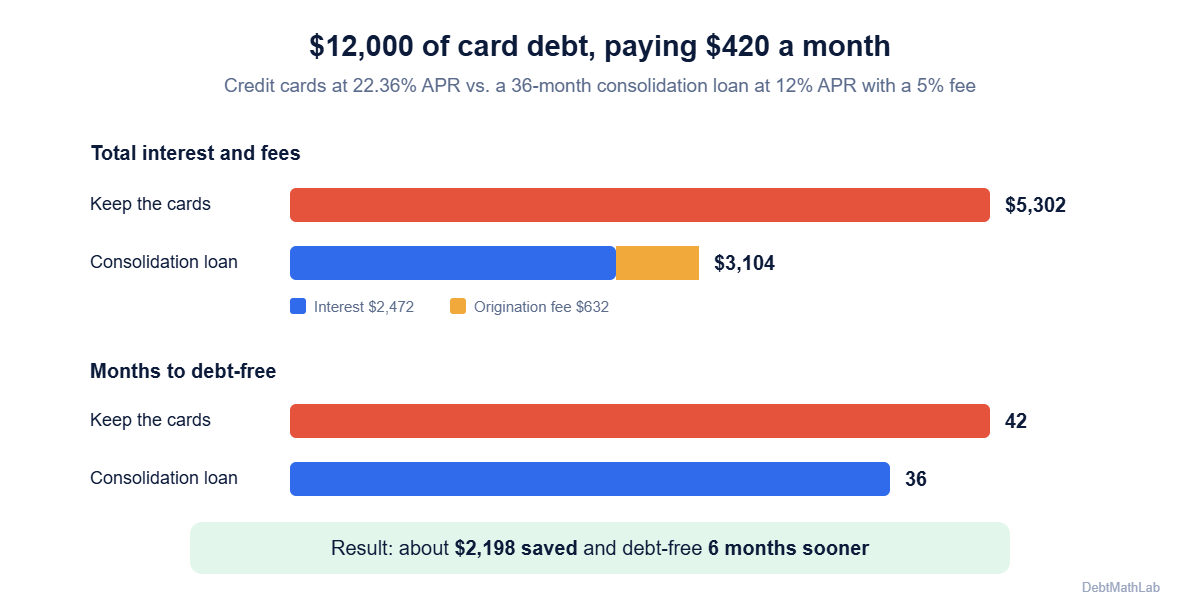
Say you owe $12,000 across three credit cards at 22.36% APR, the latest Federal Reserve average for card accounts that pay interest. You get a 36-month loan at 12% APR with a 5% origination fee, so you borrow $12,632.
| Keep the cards | Consolidation loan | |
|---|---|---|
| Monthly payment | $420 | $420 |
| Time to pay off | 42 months | 36 months |
| Interest | $5,302 | $2,472 |
| Origination fee | $0 | $632 |
| Total cost | $5,302 | $3,104 |
For the same monthly payment, the loan saves about $2,198 and gets you out of debt six months sooner, even after the fee. The savings would shrink if the loan APR were closer to 20%, or if you stretched it to five years to get a lower payment.
For the full list of benefits and drawbacks, see our guide to debt consolidation loan pros and cons.
What APR can you expect?
The Federal Reserve reports that commercial banks charged an average of 11.90% on 24-month personal loans in the third quarter of 2026, compared with 22.36% on credit card accounts that were charged interest. Those bank averages reflect borrowers with good credit. With fair or poor credit, offers from online lenders can run much higher, sometimes above 30%.
The rule is simple: if the loan’s APR isn’t clearly lower than the average rate on your current debts, consolidating won’t save you money.
What to do if you’re turned down
- Ask why. Lenders must send you a notice that explains the reasons for a denial or tells you how to request them. Fix those issues first.
- Lower your DTI. Pay down a small balance, or apply for a smaller loan.
- Add a co-signer or co-borrower with stronger credit, if someone is willing and understands they’re equally responsible.
- Try a credit union, which may look beyond your score.
- Consider a 0% balance transfer card if your credit is still good. See whether balance transfer cards actually save money.
- Talk to a nonprofit credit counselor about a debt management plan, which can lower your card rates without a new loan.
Red flags to watch for
The CFPB warns that some companies advertising “debt consolidation” are really debt settlement firms. Walk away if a company:
- Asks for fees before it has done anything
- Tells you to stop paying your creditors
- Asks you to send money into a special savings account instead of making payments
- Promises an approval or rate that sounds too good to be true
If you’re already behind and considering settlement, read how to negotiate debt settlement on your own first, so you don’t pay a company for something you can do yourself.
Getting a consolidation loan in the UK
The process is much the same in the UK. Use lenders’ and comparison sites’ soft-search eligibility checkers before you apply, compare the representative APR and the total amount repayable, and only borrow from lenders authorized by the Financial Conduct Authority. If you’re struggling, StepChange, Citizens Advice and MoneyHelper offer free debt advice.
Frequently asked questions
What credit score do you need for a debt consolidation loan?
There’s no single minimum. A score in the mid-600s or higher gives you the best chance of approval at a reasonable rate. Some lenders approve lower scores, but at higher APRs.
Does a debt consolidation loan hurt your credit?
The hard check and the new account can cause a small, short-term dip. Over time it can help, because paying off your cards lowers your credit utilization and on-time loan payments build your history.
How long does it take to get a debt consolidation loan?
Prequalifying takes minutes. After you apply, many lenders give a decision within a day and fund the loan within one to seven business days.
Can I get a debt consolidation loan with a high DTI?
It’s harder. Many lenders cap DTI at around 50%. Paying down a balance first, adding a co-borrower or applying for a smaller amount can help.
Should I close my credit cards after consolidating?
Usually not. Keeping them open with a $0 balance helps your utilization and the age of your credit. If you can’t trust yourself not to use them, put them away somewhere hard to reach rather than running them back up.
The bottom line
Getting a debt consolidation loan comes down to knowing your numbers before you apply: your credit score, your DTI, the amount you need including fees, and the APR you’re paying now. Prequalify with several lenders, choose the lowest total cost rather than the lowest payment, and pay off the old debts the moment the money arrives. Then use the loan payment calculator to check any offer, and our credit card debt guide for other ways out.
This guide is general education, not financial or legal advice. Lender rules and rates change often and depend on your situation. Consider speaking with a nonprofit credit counselor before taking on a new loan.
Featured photo by bruce mars on Unsplash. Chart by DebtMathLab.
Sources
- Federal Reserve G.19 Consumer Credit: interest rates on personal loans and credit card plans
- CFPB: What do I need to know if I’m thinking about consolidating my credit card debt?
- Experian: Personal loan fees to watch out for
- NCUA: Board extends loan interest rate ceiling
This guide is general education, not personal financial advice. For advice about your situation, talk to a qualified, licensed professional.