
Short answer: Your statement balance is what you owed when your last billing cycle closed. Your current balance is what you owe right now, including anything you’ve charged or paid since. To avoid interest on purchases, you only need to pay the statement balance in full by the due date. Paying the current balance is optional, but it can lower the balance reported to the credit bureaus and free up your available credit.
Statement balance vs current balance at a glance
| Statement balance | Current balance | |
|---|---|---|
| What it is | Everything you owed on the day your billing cycle closed | Everything you owe today |
| How often it changes | Once a month, when a new statement is issued | Every time a purchase, payment, refund or fee posts |
| Where you see it | On your monthly statement | In your card’s app or online account |
| Pay it in full to avoid interest? | Yes, by the due date | Not required, but it does no harm |
| What it means for your credit score | Usually close to the balance your issuer reports | Matters only if you pay before the statement closes |
What is a statement balance?
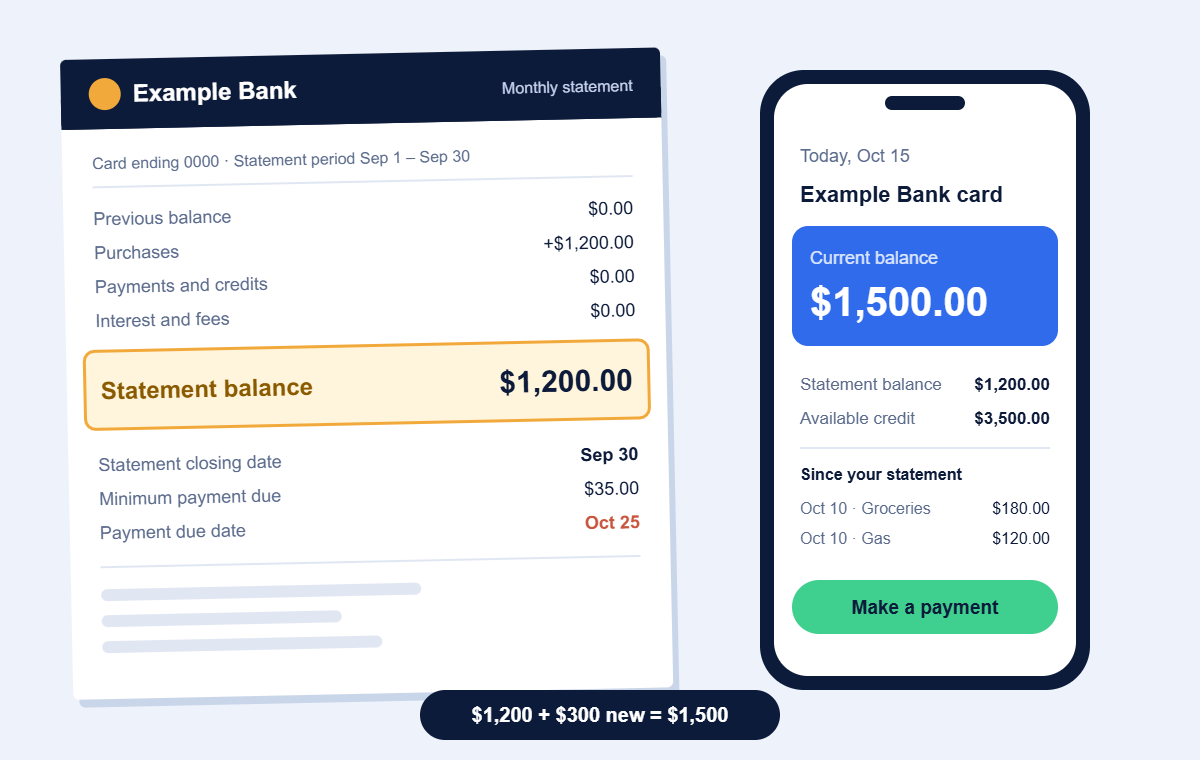
Your statement balance is the total you owed at the end of your last billing cycle, which usually runs about a month. It includes the previous balance plus new purchases, fees and interest, minus any payments and credits during that cycle. As Experian puts it, it’s the amount you owe at the end of each billing cycle, and it updates once a month.
The statement balance is the number your issuer uses to decide whether you’ve paid “in full”. It stays fixed until the next statement is issued, even if you keep using the card.
What is a current balance?
Your current balance is a running total of what you owe right now. It starts from the statement balance and moves every time something posts to your account:
- new purchases push it up
- payments, refunds and credits bring it down
- fees and interest charges push it up
Pending transactions may not be included yet. Some issuers show them separately until they post, so the current balance in your app can change again a day or two after you buy something.
A simple example
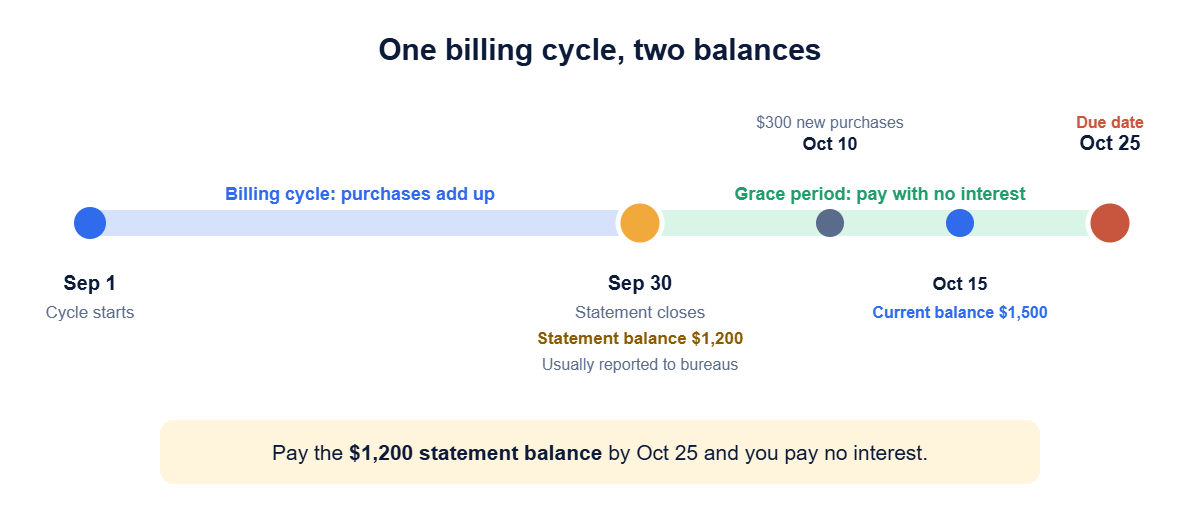
Say your billing cycle runs from September 1 to September 30, your credit limit is $5,000 and your APR is 22.36%.
- On September 30 the cycle closes. You’ve spent $1,200, so your statement balance is $1,200. Your payment is due on October 25.
- On October 10 you spend $300 on groceries and gas.
- On October 15 your app shows a current balance of $1,500: the $1,200 statement balance plus the $300 of new purchases.
| If you pay this by October 25 | What happens |
|---|---|
| $1,200 (statement balance) | No interest on purchases. The $300 rolls into next month’s statement, due in November. |
| $1,500 (current balance) | No interest, and your balance drops to $0 with the full $5,000 available again. |
| $35 (minimum payment) | No late fee, but you’ll pay about $22 interest on the $1,165 left, and the new $300 starts collecting interest too. |
That last line is the important one. Paying anything less than the full statement balance costs interest, and it can also cost you your grace period. Our credit card interest calculator shows what carrying part of the balance would cost you.
Should you pay the statement balance or the current balance?
Pay at least the statement balance, in full, by the due date. That is all you need to do to avoid interest on purchases. Paying the current balance as well is a choice, not a requirement.
When paying the statement balance is enough
- You want to avoid interest. The statement balance is the amount that counts.
- You’d rather keep cash in your checking or savings account a few weeks longer, since new purchases aren’t due until the next statement.
When paying the current balance makes sense
- You’re about to apply for a loan or mortgage and want the lowest possible balance on your report.
- You need your available credit, for example before a big purchase or a trip.
- You find it simpler to clear the card to $0 each time and not track two numbers.
Does paying the statement balance avoid interest?
Yes, for purchases, as long as you have a grace period. A grace period is the time between the end of the billing cycle and your due date when no interest is charged on new purchases. Federal rules say that if a card offers a grace period, the payment due date must be at least 21 days after the statement is sent.
A few things to know:
- Miss paying in full once, and you can lose the grace period. New purchases then start collecting interest from the day you make them, until you pay in full again, sometimes for more than one cycle.
- Residual (trailing) interest. In the first month after you clear a carried balance, you may still see a small interest charge for the days between your statement date and when your payment arrived. Pay the next statement in full and it stops.
- Cash advances and balance transfers usually have no grace period. Interest starts right away, even if you pay the statement in full.
- 0% intro offers follow their own rules. See how 0% balance transfer cards work.
For how the interest is worked out day by day, see how credit card interest is calculated.

Which balance affects your credit score?
Most issuers report your balance to the credit bureaus once a month, usually around the time your statement closes. So the balance on your credit report is normally close to your statement balance, not to what you pay later.
That matters because of credit utilization, the share of your credit limit you’re using. In the example above, a $1,200 statement balance on a $5,000 limit is reported as 24% utilization, even if you pay the full $1,200 on time.
If you want a lower number reported, pay some or all of your current balance before the statement closes, not just before the due date. Then the statement balance itself is lower. Our credit utilization calculator shows how much you’d need to pay to get under 30% or 10%.
Common questions about the two balances
Why is my current balance higher than my statement balance?
Because you’ve made purchases since the statement closed, or a fee or interest charge has posted. Those will appear on your next statement.
Why is my current balance lower than my statement balance?
You’ve made a payment, or a refund or credit has posted since the statement closed. If you’ve already paid the full statement balance, you’re done for this cycle, even if your current balance isn’t zero.
What is a “remaining statement balance”?
Some issuers show how much of the statement balance is still unpaid after the payments you’ve made. Paying that amount by the due date means you’ve paid the statement in full.
I paid my statement balance. Why do I still have a balance?
That’s normal. The balance left is new purchases made after the statement closed. They’ll be due with your next statement.
What does a negative statement balance mean?
It means you have a credit balance: the issuer owes you, usually from an overpayment or a refund. It’s used against future purchases, or you can ask for a refund.
Statement vs current balance in the UK
UK credit cards use the same two figures. Most UK cards give you an interest-free period on purchases, often up to around 56 days, but only if you pay the full statement balance by the due date each month. Pay less, and interest is usually charged on the purchases too. If you can’t clear the statement balance, set up at least the minimum by direct debit to avoid late fees and a mark on your credit file.
Paying only part of the statement balance?
If you can’t pay the full statement balance, pay as much as you can above the minimum, and see how long the debt will take with the credit card payoff calculator. Our guides to credit card minimum payments and credit card debt explain your options.
Frequently asked questions
Should I pay my statement balance or current balance?
Pay at least the full statement balance by the due date to avoid interest on purchases. Pay the current balance too if you want a lower reported balance or more available credit.
Does paying the current balance help my credit score?
Only if you pay before the statement closing date, because that’s roughly when your balance is reported. Paying it after the statement closes doesn’t change the balance already reported for that month.
Is it bad to pay only the statement balance?
No. Paying the statement balance in full is all you need to avoid interest on purchases and keep your account in good standing.
Do I pay interest on my current balance?
Not if you paid the last statement in full and still have your grace period. New purchases are only charged interest if you carry part of a statement balance past its due date.
Is the statement balance the same as the minimum payment?
No. The minimum payment is a small part of the statement balance. Paying only the minimum keeps the account current but leaves the rest collecting interest.
The bottom line
The statement balance is your monthly bill, and the current balance is your live total. Pay the statement balance in full by the due date and you won’t pay interest on purchases. Pay down the current balance before the statement closes if you also want a lower balance reported to the credit bureaus.
This guide is general education, not personal financial advice. Examples assume a 22.36% APR (Federal Reserve average for accounts assessed interest) and a card with a grace period. Your card agreement sets your actual terms.
Featured photo by Vitaly Gariev on Unsplash. Statement and timeline graphics by DebtMathLab.
Sources
- Experian: current balance vs statement balance
- NerdWallet: how credit card grace periods work
- Consumer Financial Protection Bureau: Regulation Z, limits on interest charges (12 CFR 1026.54)
- Federal Reserve G.19: credit card interest rates
This guide is general education, not personal financial advice. For advice about your situation, talk to a qualified, licensed professional.