Short answer: A credit card minimum payment is the smallest amount you must pay by the due date to keep your account in good standing. It is usually about 1% of your balance plus that month’s interest, or 2% to 4% of the balance, with a floor of around $25 to $40. Paying it on time protects your credit history, but paying only the minimum keeps you in debt for years and costs far more in interest.
What is a minimum payment on a credit card?
Every month your statement shows two key numbers: the statement balance (everything you owed at the end of the billing cycle) and the minimum payment due. The minimum is the lowest amount the card issuer will accept without treating your payment as late.
Paying the minimum avoids a late fee and keeps the account current. It does not avoid interest. Only paying the full statement balance by the due date does that.
How is the minimum payment calculated?
There is no single formula. Each issuer sets its own, and it is explained in your card agreement. According to Experian, the most common methods are:
- Interest plus a percentage: that month’s interest and fees, plus about 1% of the balance.
- A flat percentage: usually 2% to 4% of the balance.
- A dollar floor: a minimum such as $25 or $35. If your balance is below the floor, the whole balance is due.
Any late fees or past-due amounts are usually added on top.
Example: a $3,000 balance at 22.36% APR
| Method | Calculation | Minimum payment |
|---|---|---|
| Interest + 1% | $55.90 interest + $30.00 | $85.90 |
| 2% of balance | 2% × $3,000 | $60.00 |
| Dollar floor | Only applies to small balances | $25 to $40 |
The interest figure comes from the monthly rate: 22.36% ÷ 12 = 1.86%, and 1.86% of $3,000 is about $55.90. For the full method, see how credit card interest is calculated. Or enter your own balance and APR in the credit card interest calculator.
Does paying the minimum payment hurt your credit score?
No, paying the minimum on time does not hurt your credit score by itself. But carrying a large balance can hold your score down.
Two parts of your score are involved. In FICO’s model, payment history counts for 35% and amounts owed for 30%:
- Payment history: an on-time minimum payment counts as a payment made, so this part stays positive.
- Amounts owed: paying only the minimum keeps your balance high compared with your credit limit. A high credit utilization ratio can lower your score until the balance comes down.
So the minimum protects your record, while paying more than the minimum is what improves your score over time.
Is it bad to only pay the minimum?
It is not bad for your credit history, but it is the most expensive way to repay a card. Because the minimum shrinks as your balance shrinks, the debt drags on for years.
| $3,000 at 22.36% APR | Time to pay off | Total interest |
|---|---|---|
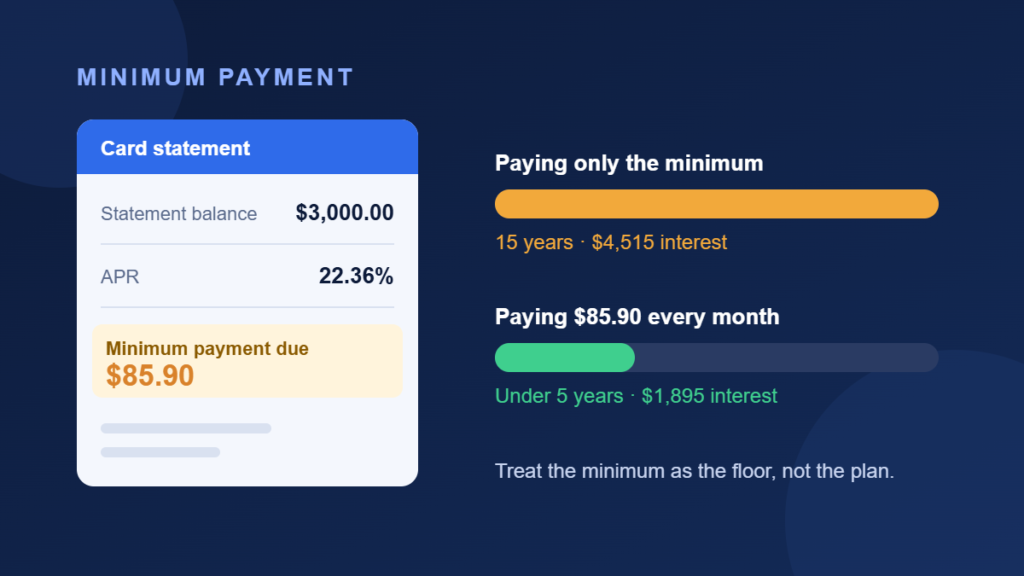
| Minimum only (interest + 1%, starting at $85.90) | 15 years | $4,515 |
| Fixed $85.90 every month | 57 months | $1,895 |
Simply keeping your payment at the first month’s minimum, instead of letting it fall, saves about 10 years and $2,620. You can try your own numbers in the credit card payoff calculator, and see more examples in how long it takes to pay off a credit card.
Your statement also shows this. The CFPB explains that card statements include a box showing how long the balance takes with minimum payments only, and how much you would need to pay to clear it in three years.
Why did my minimum payment go up?
A higher minimum usually has one of these causes, as Experian lists:
- Your balance grew. Most formulas are based on the balance, so new spending raises the minimum.
- Your interest rate went up. A higher APR, including a penalty APR after a late payment, means more interest in the minimum.
- A late fee or past-due amount was added. These are usually included in the next minimum.
- A promotional rate ended. When a 0% period ends, interest starts appearing in the minimum.
- A cash advance or installment plan. Cash advance fees and interest, or a monthly installment from a financing plan, are added on top.
Why is my minimum payment $0?
A $0 minimum usually means you have no balance due for that statement, for example because you paid it off before the statement closed, or a refund or credit covered it. Some cards also allow a skipped payment during a hardship program. Check your statement to be sure nothing is owed.
What happens if you pay less than the minimum?
Paying less than the minimum, or nothing, counts as a missed payment:
- You will usually be charged a late fee.
- A penalty APR may apply, and a promotional 0% rate can end.
- Once a payment is 30 days past due, it is typically reported to the credit bureaus and can lower your score.
If you can’t make the minimum, call your issuer before the due date and ask about a hardship program.
How to lower your minimum payment
The fastest way to lower your minimum is to lower your balance or your rate:
- Move the balance to 0%. With no interest, the minimum drops. See how 0% balance transfer cards work.
- Ask for a lower APR. After a year of on-time payments, issuers often agree.
- Consolidate. A fixed-rate loan replaces several minimums with one payment. See debt consolidation pros and cons.
- Get free help. A nonprofit credit counselor may set up a plan with reduced interest.
A lower minimum only helps if you keep paying more than it. For the full picture of your options, see our guide to credit card debt.
Frequently asked questions
Do I have to pay more than the minimum?
No. The minimum is all you are required to pay to keep the account current. Paying more reduces your interest and gets you out of debt faster.
Does paying the minimum avoid interest?
No. Interest is charged on any part of the statement balance you don’t pay by the due date. Only paying the full statement balance avoids interest on purchases.
Is the minimum payment the same as the statement balance?
No. The statement balance is everything you owed when the billing cycle closed. The minimum payment is a small part of it.
How much should I pay on my credit card?
Ideally the full statement balance. If you can’t, pay a fixed amount you can keep every month, well above the minimum, and avoid new charges until the card is paid off.
The bottom line
The minimum payment keeps your account in good standing and protects your credit history, but it is designed to keep you paying for years. Treat it as the floor, not the plan: pick a fixed monthly amount above it and check your payoff date in the credit card payoff calculator.
This article is for general information and is not financial advice. Examples use a 22.36% APR (Federal Reserve average for accounts assessed interest, August 2026), monthly compounding and no new charges. Your card agreement sets your actual minimum payment formula.
Sources
- Experian: what is a credit card minimum payment
- Experian: why did my minimum payment go up
- myFICO: what’s in your credit score
- Consumer Financial Protection Bureau: the minimum payment box on your statement
- Federal Reserve Bank of St. Louis (FRED): credit card interest rate, accounts assessed interest
This guide is general education, not personal financial advice. For advice about your situation, talk to a qualified, licensed professional.