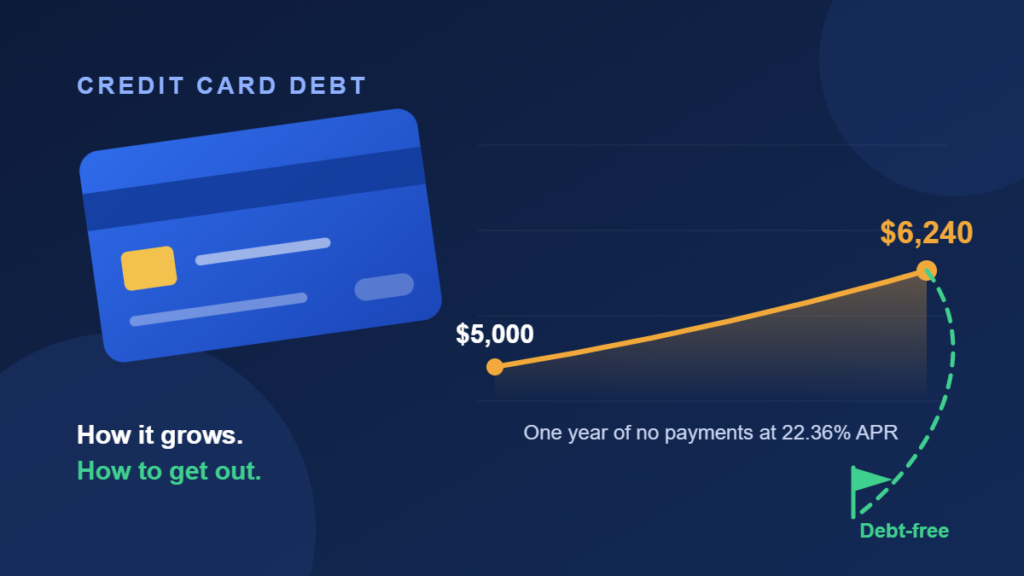
Credit card debt is the balance you carry on a credit card from one month to the next. Once you carry a balance, the card charges interest on it, which at today’s average rate of 22.36% APR makes it one of the most expensive kinds of debt you can have. Americans owed $1.263 trillion on credit cards in mid-2026, up $54 billion in a year.
This guide explains how credit card debt works, why it grows so fast, how much of it Americans carry, and which ways out fit which situations. Each option links to a deeper guide or calculator, so you can go straight to the one that fits you.
What is credit card debt?
A credit card is a revolving line of credit. You can borrow up to your limit, repay, and borrow again. Credit card debt is whatever part of that balance you don’t pay off by the due date.
- If you pay the full statement balance by the due date, most cards charge no interest on purchases. This interest-free window is called the grace period.
- If you pay less than the full balance, the rest becomes debt. Interest is charged on it, and usually on new purchases too, until you pay the card off in full again.
Credit card debt is unsecured: nothing like a house or car backs it. That is one reason card rates are so much higher than mortgage or auto loan rates.
How credit card debt grows
Credit card interest compounds. Each month’s interest is added to the balance, and next month’s interest is charged on that larger number.
At 22.36% APR, the card charges about 1.86% a month. On a $5,000 balance that is roughly $93 in the first month. If you made no payments for a year, the same $5,000 would grow to about $6,240, before any late fees.
Most issuers work this out daily on your average daily balance. Our guide on how credit card interest is calculated walks through the daily method step by step.
Minimum payments slow this down but rarely stop it. Because the minimum shrinks as the balance shrinks, paying only the minimum on $5,000 can take more than 19 years to clear.
How much credit card debt do Americans have?
US credit card balances reached $1.263 trillion in the second quarter of 2026, up $54 billion from a year earlier, according to the Federal Reserve Bank of New York.
| Measure | Latest figure | Source |
|---|---|---|
| Total US credit card balances | $1.263 trillion (Q2 2026) | New York Fed |
| Change from a year earlier | +$54 billion | New York Fed |
| Average APR on accounts paying interest | 22.36% (August 2026) | Federal Reserve G.19 |
| Average APR across all accounts | 21.19% (August 2026) | Federal Reserve G.19 |
| Adults with a credit card | 82% (2025) | Federal Reserve SHED |
| Cardholders who carried a balance at least once in 12 months | 45% (2025) | Federal Reserve SHED |
| Card balances moving into serious delinquency (90+ days), annualized | 6.97% (Q2 2026) | New York Fed |
In plain terms: most adults have a card, nearly half of them carried a balance at some point last year, and the rate they paid on that balance was over 22%.
Signs your credit card debt is becoming a problem
Carrying a small balance for a month or two is common. These signs suggest the debt is starting to control your budget:
- You can only afford the minimum payment, month after month.
- Your balance is higher than it was six months ago, even though you pay every month.
- You use one card, or a cash advance, to pay another.
- Your balances are close to your credit limits.
- You have no savings to cover a car repair or medical bill, so it would go on a card.
If two or more of these apply, it is worth making a plan now, while you are still current on payments and have the most options.
What happens if you stop paying credit card debt?
Missing payments makes the debt more expensive and harder to escape.
- Late fees and a higher rate. Your card agreement sets the late fee, and many cards can apply a higher penalty APR after a serious delay (see what happens if you miss a credit card payment).
- Credit damage. Payments that are 30 days or more late are typically reported to the credit bureaus, which can lower your score sharply.
- Charge-off and collections. After about 120 to 180 days without payment, the issuer usually charges the account off as a loss. You still owe the debt, and it may be sold to a debt collector. A charge-off can stay on your credit report for up to seven years.
If you are close to missing a payment, call your card issuer before the due date. Many have hardship programs that lower the rate or payment for a while.
How to get out of credit card debt: your options
The best route depends on how much you owe, your credit score, and how many cards you have. Here is a quick map, with a deeper guide for each.
| Option | Works best when | Learn more |
|---|---|---|
| Fixed monthly payment | You have one card and can pay more than the minimum | How long it takes to pay off a card |
| Debt avalanche | You have several cards and want to pay the least interest | Debt avalanche calculator |
| Debt snowball | You have several cards and want quick wins to stay motivated | Debt snowball calculator |
| 0% balance transfer | Your credit is good and you can clear the balance in the promo period | Will a balance transfer save you money? |
| Debt consolidation loan | You qualify for a loan rate well below your card rates | Debt consolidation pros and cons How to get a consolidation loan |
| Nonprofit credit counseling | Payments are already hard to make | CFPB: what is credit counseling |
Not sure whether to use snowball or avalanche? Our debt snowball vs. avalanche comparison runs both on the same example. For a step-by-step plan from start to finish, see how to pay off credit card debt fast.
Whichever route you choose, it works faster with extra cash each month. These ways to find an extra $100 a month are a good place to start.
Should you pay off credit card debt or save first?
For most people, a small emergency fund comes first, then the card debt. Without any cash buffer, the next surprise bill goes straight back on the card. Once you have that buffer, paying off a card at 22% beats almost any savings account or investment return.
Read more in emergency fund or pay off debt first and pay off debt or invest.
Credit card debt in the UK
The same math applies in pounds, but UK card rates are usually higher. The average UK credit card purchase APR reached 35.8% in February 2026, a 20-year high, according to Moneyfacts.
UK cardholders also have extra protection. Under FCA persistent debt rules, card providers must step in when someone has paid more in interest and charges than off the balance over 18 months, and offer help after 36 months. Free debt advice is available from MoneyHelper, StepChange and National Debtline.
Frequently asked questions
Is credit card debt bad?
Using a card is not bad, and paying it in full each month costs nothing in interest. Carrying a balance is expensive: at 22.36% APR, $5,000 costs about $1,118 a year in interest if the balance stays the same.
How much credit card debt is too much?
There is no single number. Warning signs are paying only the minimum, balances near your limits, and a balance that keeps rising. Many lenders also look at whether your total debt payments take up more than about a third of your monthly income (check yours with our debt-to-income ratio calculator).
Does credit card debt go away after 7 years?
Not exactly. Most negative marks, including a charge-off, drop off your credit report after about seven years, but the debt itself can still be owed. How long a creditor can sue you over it depends on your state’s statute of limitations.
Can credit card debt be forgiven?
Sometimes a creditor will settle for less than the full balance, usually after the account is badly behind. Settlement damages your credit, and forgiven debt can count as taxable income. Credit counseling or a hardship program is usually a safer first step. If you do go this route, here is how to negotiate a debt settlement yourself.
What is the fastest way to pay off credit card debt?
Pay a fixed amount well above the minimum, stop adding new charges, and if you have good credit, move the balance to a 0% card. Run your numbers in the credit card payoff calculator to see your debt-free date.
The bottom line
Credit card debt is easy to build and slow to clear because interest keeps compounding on what you owe. The good news is that it also responds quickly to a plan. Pick the option that fits your situation, set a fixed payment, and track your progress.
Start by entering your balance, APR and monthly payment in our credit card payoff calculator. It shows your payoff month and total interest in seconds.
This article is for general information and is not financial advice. Figures are the latest published at the time of writing; check your own card agreement for your rate and fees.
Sources
- Federal Reserve Bank of New York: Household Debt and Credit Report, Q2 2026 (August 11, 2026)
- Federal Reserve: Consumer Credit G.19 (October 7, 2026 release, August 2026 data)
- Federal Reserve: Economic Well-Being of U.S. Households in 2025, Credit
- Capital One: what is a credit card charge-off
- Consumer Financial Protection Bureau: what is credit counseling
- Moneyfacts: cost to borrow on credit cards hits 20-year high (February 2026)
- Financial Conduct Authority: new credit card rules (persistent debt)
This guide is general education, not personal financial advice. For advice about your situation, talk to a qualified, licensed professional.