
Short answer: If you miss a credit card payment, you’ll usually be charged a late fee right away, and you’ll pay interest on the unpaid balance. If you pay within 30 days, it normally won’t be reported to the credit bureaus. Once a payment is 30 or more days late, it can be reported, lower your credit score and stay on your credit report for up to seven years. At 60 days late, you may also face a penalty APR. The sooner you pay, the less damage it does.
What happens if you miss a credit card payment: the timeline
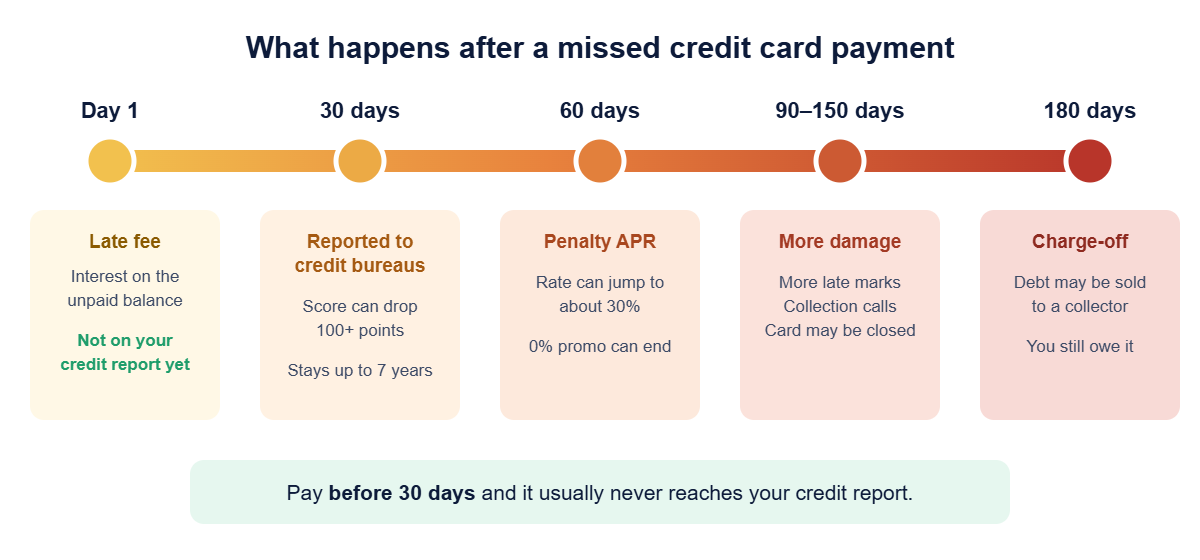
The consequences grow the longer the payment goes unpaid. Here is what typically happens, based on guidance from Capital One and federal rules. Your card agreement has the exact terms.
| How late | What usually happens |
|---|---|
| 1 day late | A late fee may be charged. Interest is charged on the unpaid balance. If you had no balance carried, you may lose your grace period on new purchases. |
| 30 days late | The issuer can report the late payment to Experian, Equifax and TransUnion. Your credit score can drop sharply. |
| 60 days late | A penalty APR may apply to your balance, and a 0% intro rate can end early. Another late mark is reported. |
| 90 to 150 days late | More late marks, more fees and interest, collection calls, and the card may be frozen or closed. |
| 180 days late | The account is usually charged off and may be sold to a debt collector. You still owe the money. |
What counts as a late credit card payment?
A payment is late if the issuer doesn’t receive at least the minimum payment by the due date. Under federal rules, a payment received by 5 p.m. on the due date must be counted as on time. If the due date falls on a weekend or holiday when payments aren’t accepted, a payment on the next business day counts as on time.
Paying less than the minimum counts as a missed payment too, even if you paid most of it.
Is one day late on a credit card payment a big deal?
Usually not for your credit score, but it still costs money. A payment that is a few days late is generally not reported to the credit bureaus, because issuers typically report a payment as late only once it is at least 30 days past due.
What a one-day-late payment can still cost you:
- A late fee. Your card agreement sets the amount, often around $30 to $40. Federal rules say the fee can’t be more than the minimum payment that was due.
- Interest. You’ll pay interest on any unpaid balance, and if you had been paying in full, you may lose your grace period for a cycle or more. See statement balance vs current balance for how the grace period works.
Pay as soon as you notice, and then call to ask for the fee to be waived. If it’s your first late payment, many issuers will agree.
How does a missed payment affect your credit score?
Payment history is the biggest factor in your score. In FICO’s model it makes up 35% of your score. A single payment reported 30 days late can lower a good score by more than 100 points. People with higher scores often lose more, because they have further to fall.
The damage also grows with how late the payment gets. A 90-day late mark hurts more than a 30-day one, and a charge-off hurts more still.
How long does a late payment stay on your credit report?
Up to seven years from the date of the missed payment. The effect fades over time, though: a late payment from five years ago matters much less than one from last month, especially if every payment since has been on time.
Penalty APR: when your interest rate goes up
If you are 60 or more days late, many issuers can apply a penalty APR, often around 29.99%, to your existing balance. Federal rules then require the issuer to review it and return you to your normal rate if you make six months of on-time payments.
The cost adds up, because credit card interest is charged on your balance every month. On a $3,000 balance:
| $3,000 balance | Monthly interest | Interest over a year |
|---|---|---|
| Regular APR, 22.36% | about $56 | about $671 |
| Penalty APR, 29.99% | about $75 | about $900 |
That’s about $229 more a year on the same balance. If you were on a 0% promotional rate, being more than 60 days late can also end the promotion early, so the whole balance starts collecting interest. See how 0% balance transfer cards work.
What to do if you missed a credit card payment
- Pay at least the minimum right away. If you pay before the 30-day mark, the late payment usually never reaches your credit report.
- Call your issuer. Explain what happened and ask them to waive the late fee and any penalty rate. A good record makes a “yes” much more likely.
- Ask for a goodwill adjustment if a late payment was already reported. Issuers don’t have to remove an accurate late mark, but some will after a long on-time history.
- Check your credit reports at AnnualCreditReport.com. If a late payment was reported by mistake, dispute it with the credit bureau.
- Set up autopay for at least the minimum, so it can’t happen again. You can still pay more by hand each month.

If you can’t make the payment at all
Don’t simply stop paying. Call your card issuer before the due date, or as soon as you can, and ask about a hardship program. Many issuers can lower your rate, waive fees or reduce your payment for a few months.
If the account has already been charged off or sent to a collector, you may be able to settle it for less than you owe. Our guide on how to negotiate debt settlement on your own walks through the offer, the call and the paperwork.
Other options to look at:
- Nonprofit credit counseling. A counselor can review your budget and may set up a debt management plan with lower interest rates.
- A balance transfer or consolidation loan, if your credit is still good enough to qualify. See debt consolidation pros and cons.
- A clear payoff plan. Our credit card payoff calculator shows how long your balance will take and what a bigger payment saves.
For every option in one place, see our guide to credit card debt.
How to avoid missing a payment
- Autopay the minimum from your checking account as a safety net.
- Move your due date. Most issuers let you pick a date that falls just after payday.
- Turn on alerts for upcoming due dates and low balances.
- Keep a small emergency fund so a surprise bill doesn’t leave you short. See emergency fund vs paying off debt.
Missing a credit card payment in the UK
In the UK, a missed or late payment usually brings a fee of up to £12, and interest on the balance. The missed payment can be recorded on your credit file and stays there for six years. If you miss several payments, your provider may send a default notice. If you’re struggling, contact your card provider early, and get free advice from StepChange, Citizens Advice or MoneyHelper.
Frequently asked questions
What happens if you miss one credit card payment?
You’ll usually pay a late fee and interest. If you pay within 30 days, it generally won’t be reported to the credit bureaus or affect your credit score.
How late can a credit card payment be before it hurts your credit?
Most issuers report a late payment once it is 30 days past the due date. Paying before then usually keeps it off your credit report, though you may still owe a late fee.
Will one late payment ruin my credit?
No. It can lower your score noticeably at first, but the effect fades with time, especially if you make every payment on time afterward.
Can a late payment be removed from my credit report?
If it was reported in error, yes: dispute it with the credit bureau. If it’s accurate, you can ask the issuer for a goodwill removal, but they don’t have to agree.
Can I get a late fee waived?
Often, yes, especially for a first late payment. Pay the amount due, call your issuer and ask politely.
The bottom line
A missed credit card payment costs a late fee and interest straight away, but the real damage starts at 30 days late, when it can reach your credit report. Pay as soon as you can, call your issuer to ask for the fee to be waived, and set up autopay so it doesn’t happen again.
This guide is general education, not personal financial advice. Late fees, penalty rates and reporting practices vary by issuer. Check your card agreement for your exact terms. Example uses a 22.36% APR (Federal Reserve average for accounts assessed interest) and a 29.99% penalty APR.
Featured photo by Vitaly Gariev on Unsplash. Timeline graphic by DebtMathLab.
Sources
- Capital One: what you should know about late credit card payments
- myFICO: what’s in your credit score
- Consumer Financial Protection Bureau: Regulation Z (Truth in Lending)
- Federal Reserve G.19: credit card interest rates
This guide is general education, not personal financial advice. For advice about your situation, talk to a qualified, licensed professional.